Ethics and the Limits of Philosophy (Routledge Classics) by Bernard Williams
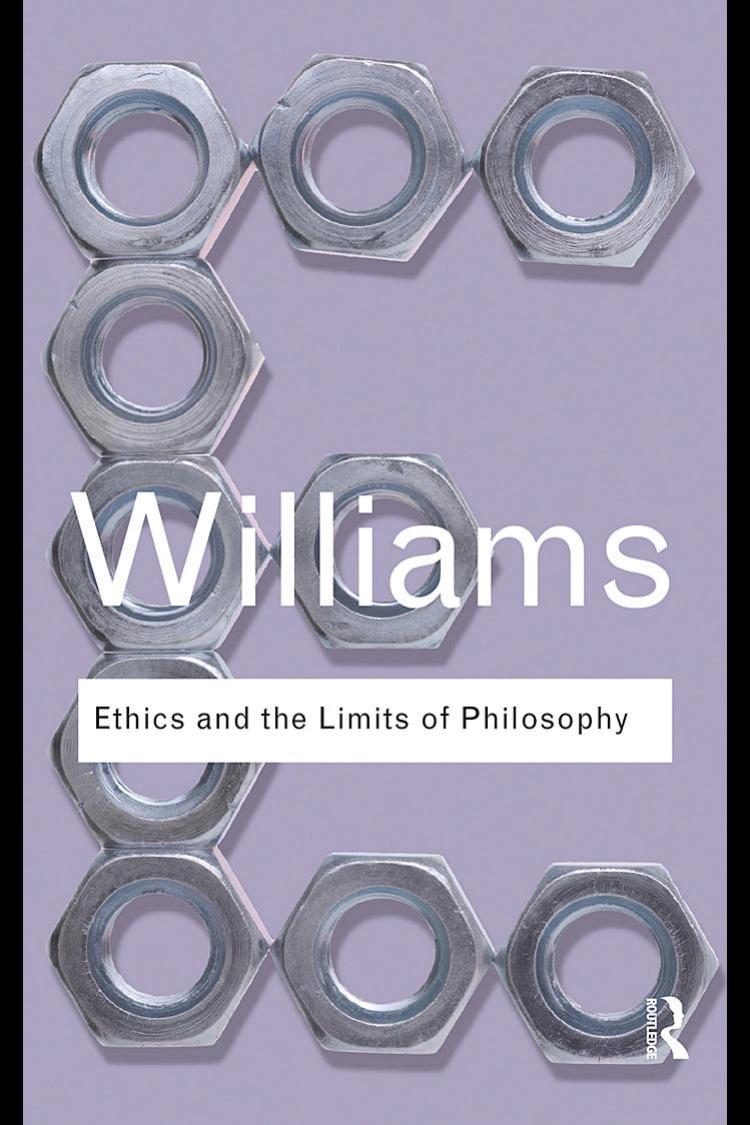
Author:Bernard Williams [Williams, Bernard]
Language: eng
Format: epub, pdf
Publisher: Taylor & Francis
Published: 2011-03-31T16:00:00+00:00
It has been reasonably doubted whether Hume himself meant by this passage what has subsequently been made of it.3 He indeed thought, and explicitly says, that attention to this point would “let us see, that the distinction of vice and virtue is not founded merely on the relations of objects, nor is perceiv’d by reason.” But the relation of that kind of conclusion to matters of definition and logical deduction is not straightforward.
The phrase “naturalistic fallacy” is now often used for breaches of this ban on deriving ought from is. At the same time, it retains its original force with respect to good and other such evaluative expressions. Some more theory is needed to explain why a ban involving ought will equally yield a ban involving good. That theory takes the form of applying the reductionist strategy, treating good as definable in terms of ought. This is one of the deeper motives for the reductionist strategy. If we are convinced that there must be two fundamental classes of expression, one related to value and the other to fact, it is natural to see one member of the value class as basic, while others are to be defined in terms of it.
This seems all the more natural when we consider a particular way in which modern theorists have tried to explain why we cannot derive the evaluative from the nonevaluative. Moore himself thought that goodness was indefinable just because it was a simple nonnatural quality. He also thought that the presence of this quality was detected by intuition, in the sense of that intellectual power discussed in the last chapter as the basis of one kind of “intuitionism.” Intuitionism in that sense does not explain anything much, and it does not do a great deal to explain why values cannot be derived from facts.
More recent work has tried to give a better explanation. It takes as central the ban on deriving ought from is. The central view is prescriptivism, developed by Hare, which explains the function of ought in terms of prescribing an action, or telling someone what to do. Ought is seen as being like an imperative: strictly speaking, a statement employing ought used in the normal prescriptive way is a universal expression that entails imperatives applying to all agents in all similar circumstances. (We have already seen the use of this idea in Hare’s development of World Agent utilitarianism.) On this interpretation, what I have up to now been calling the evaluative will more revealingly be called the prescriptive, and it is the prescriptive that cannot be validly derived from the other class of statements—a class that, in this contrast, is appropriately labeled the descriptive. The explanation of the ban is now fairly obvious. The prescriptive does something, namely telling people to act in certain ways, which the descriptive, in itself, cannot do. This gives a clear reason for that ban, but if the ban is to be as general as was originally hoped, and is to explain the
Download
Ethics and the Limits of Philosophy (Routledge Classics) by Bernard Williams.pdf
This site does not store any files on its server. We only index and link to content provided by other sites. Please contact the content providers to delete copyright contents if any and email us, we'll remove relevant links or contents immediately.
| Anthropology | Archaeology |
| Philosophy | Politics & Government |
| Social Sciences | Sociology |
| Women's Studies |
The remains of the day by Kazuo Ishiguro(8999)
Tools of Titans by Timothy Ferriss(8393)
Giovanni's Room by James Baldwin(7346)
The Black Swan by Nassim Nicholas Taleb(7129)
Inner Engineering: A Yogi's Guide to Joy by Sadhguru(6793)
The Way of Zen by Alan W. Watts(6614)
The Power of Now: A Guide to Spiritual Enlightenment by Eckhart Tolle(5781)
Asking the Right Questions: A Guide to Critical Thinking by M. Neil Browne & Stuart M. Keeley(5775)
The Six Wives Of Henry VIII (WOMEN IN HISTORY) by Fraser Antonia(5515)
Astrophysics for People in a Hurry by Neil DeGrasse Tyson(5189)
Housekeeping by Marilynne Robinson(4447)
12 Rules for Life by Jordan B. Peterson(4304)
Ikigai by Héctor García & Francesc Miralles(4274)
Double Down (Diary of a Wimpy Kid Book 11) by Jeff Kinney(4271)
The Ethical Slut by Janet W. Hardy(4251)
Skin in the Game by Nassim Nicholas Taleb(4248)
The Art of Happiness by The Dalai Lama(4130)
Skin in the Game: Hidden Asymmetries in Daily Life by Nassim Nicholas Taleb(4006)
Walking by Henry David Thoreau(3962)
